AQ Test Results: A Guide to Discussing Your Score with Healthcare Providers
You've just completed the Autism Spectrum Quotient (AQ) test and have your score. It’s a moment that can bring a mix of clarity, confusion, and maybe some anxiety. You might be asking yourself, "What do I do with this information now?" This is a common and completely valid question. While an AQ score is a valuable piece of self-knowledge, it isn't a medical diagnosis. The next step for many is talking to a healthcare professional.
Navigating that conversation can feel intimidating. This guide is here to help. We'll provide a clear, step-by-step framework for discussing your AQ test results with a doctor or therapist. Our goal is to empower you to advocate for your health with confidence and clarity. The journey to understanding yourself often begins with a single step, like taking a free AQ test. This article will help you take the next one.
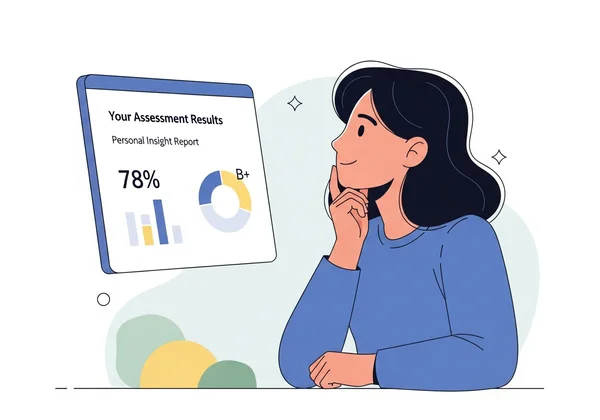
Understanding Your AQ Test Results: Clinical Context
Before you schedule an appointment, it's crucial to put your AQ score into perspective. A screening tool like the AQ test is designed to identify traits associated with the autism spectrum. It is not a diagnostic tool. Instead, it serves as a starting point for a more in-depth conversation. Healthcare providers see it as one piece of a much larger puzzle.
Think of your score as a well-organized set of observations. It provides a structured way to examine your social skills, communication preferences, attention to detail, and sensory experiences. A professional will use this information alongside your personal history, developmental background, and direct observation to build a comprehensive clinical picture.
What Your AQ Score Really Means
Your AQ score, on a scale of 0 to 50, indicates the number of autistic traits you report experiencing. It's easy to get fixated on the number, but its true value lies in what it represents. A higher score suggests you may share many traits common among autistic individuals, while a lower score suggests you share fewer. There is no "good" or "bad" score; it's simply data.
When discussing your results, focus on the patterns, not just the number. For instance, you can explain that the test highlighted difficulties with understanding social cues or a strong preference for routines. These concrete examples are far more useful to a clinician than the score alone. They provide a window into your daily life and the specific challenges or differences you experience.
Preparing for Your Healthcare Conversation About AQ Test Results
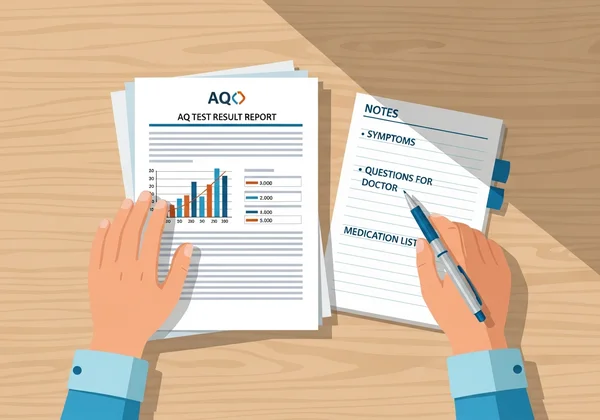
Preparation is key to a productive and less stressful appointment. Going in with organized thoughts and documents can make a world of difference. It shows your provider that you have thoughtfully considered your experiences and are serious about seeking clarity.
Here’s a simple checklist to help you prepare:
-
Document Your Traits: Write down specific examples from your life that relate to the questions on the AQ test. Think about your childhood, school experiences, work life, and personal relationships.
-
List Your Questions: What do you want to learn from this appointment? Write down your questions for the doctor, such as "What are the next steps for a formal assessment?" or "How can I manage sensory overload?"
-
Bring Your Results: Print out your AQ test results. If you received an AI-powered personalized report from our platform, bring that too. It offers deeper insights that can guide the conversation.
-
Gather Relevant History: If possible, collect any old school reports, performance reviews, or notes that mention social difficulties, intense interests, or other relevant traits.
Effectively Communicating AQ Test Results to Doctors
The way you communicate your concerns is just as important as the information you bring. Many adults seeking an autism diagnosis worry about not being taken seriously. A calm, clear, and evidence-based approach can help you bridge that gap and build a collaborative relationship with your doctor.
Remember, you are the expert on your own life. Your lived experience is valid and essential to the diagnostic process. The goal of this conversation is to share your expertise in a way your provider can understand and act upon. It's a partnership, not a test.

Scripts for Discussing Your AQ Results
Starting the conversation is often the hardest part. Having a few opening lines prepared can reduce anxiety. You can adapt these scripts to fit your personal style and situation.
Direct Approach:
"Hello, Doctor. I'm here today because I have some questions about the possibility of being on the autism spectrum. I recently took an online AQ test and my score was [Your Score]. I'd like to discuss what this might mean and what the next steps could be for a formal evaluation."
Experience-Focused Approach:
"I've been struggling with [mention a specific challenge, e.g., social situations or sensory sensitivities] for a long time. While researching my experiences, I came across the AQ test. The results seemed to align with how I feel, and I'd like to explore this further with you."
If you have our AI Report:
"I took a free online AQ test and also received a personalized AI report that highlighted specific traits, like [mention a point from the report]. It was very insightful, and I'd like to get your professional opinion on it."
Questions Your Doctor Might Ask (And How to Answer)
A good clinician will ask many questions to understand your situation better. Being prepared for them can help you provide clear and helpful answers. They are not trying to "catch you out" but to gather the necessary information for a thorough assessment.
Common questions include:
- "Why do you think you might be autistic?"
- How to answer: Refer to your list of documented traits and life examples. Instead of saying "I'm just different," say "I consistently find it hard to understand what people mean when they are not direct" or "I have always had intense, narrow interests."
- "What was your childhood like?"
- How to answer: Share memories about your social interactions, friendships (or lack thereof), play style, routines, and sensory issues as a child. If you don't remember, it's okay to say so.
- "How do these traits affect your daily life now?"
- How to answer: Give concrete examples from your work, home life, and relationships. For instance, "At work, open-plan offices are overwhelming for me due to the noise," or "I often feel exhausted after socializing and need a full day to recover."
Navigating Potential Diagnostic Hurdles
Unfortunately, not all healthcare providers are well-versed in adult autism, especially in women and gender-diverse individuals. You may encounter skepticism or outdated beliefs. It's important to be prepared for this possibility and to advocate for yourself calmly. Finding a provider who listens and has the right expertise is a crucial part of your healthcare journey.
If your doctor seems dismissive, you can say:
"I understand that adult autism diagnosis is complex. The information I've read from reputable sources suggests my experiences are consistent with the spectrum. Could you refer me to a specialist who has more experience with adult autism assessments?"
Remember, it is okay to seek a second opinion. A good first step is understanding your traits, which you can begin to explore with an online autism screening.
Your Rights After Receiving AQ Test Results
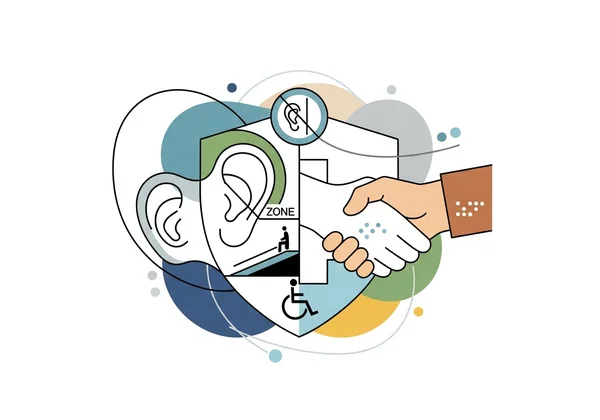
Knowing your rights as a patient is a powerful form of self-advocacy. In many countries, you have the right to be treated with respect, to be involved in your care decisions, and to access your medical records. You also have the right to request reasonable accommodations to make the healthcare experience more accessible for you.
This is especially important for autistic individuals, as the clinical environment itself can be a source of stress. Bright lights, unexpected noises, confusing instructions, and long waits can be overwhelming. Advocating for a more comfortable environment is not asking for special treatment; it's asking for equitable access to care.
Understanding Your Patient Rights
As a patient, you generally have the right to:
- Informed Consent: Your doctor must explain your options, including the risks and benefits, so you can make an informed choice about your care.
- A Second Opinion: If you are unsure about a diagnosis or treatment plan, you have the right to seek an opinion from another provider.
- Confidentiality: Your health information is private and should be protected.
- Respectful Care: You should be treated with dignity, regardless of your background or neurological differences.
If you feel your rights are not being respected, most healthcare systems have a patient advocacy or complaints department you can contact.
Requesting Reasonable Accommodations
You can and should ask for changes that make your appointment more manageable. Many clinics are happy to help if they know what you need. You can make these requests when you book your appointment.
Here are some examples of accommodations you might request:
- Communication: "Could the doctor please write down the key points of our discussion? It helps me process information."
- Sensory Environment: "Is it possible to wait in a quieter area instead of the main waiting room? Loud spaces are very stressful for me."
- Scheduling: "Could I have the first appointment of the day to minimize waiting time and anxiety?"
- Support Person: "I would like to bring my partner or a friend with me to the appointment for support. Is that okay?"
These small adjustments can transform a stressful experience into a productive one.
Next Steps
Taking your AQ test results to a healthcare provider is a significant step toward self-understanding and getting the right support. It requires courage, preparation, and a willingness to advocate for yourself. Remember, this is your journey, and you are in the driver's seat.
Let’s recap the key strategies for effective healthcare advocacy:
- Prepare Thoroughly: Document your experiences and write down your questions.
- Communicate Clearly: Use specific examples and focus on how your traits impact your daily life.
- Know Your Rights: Understand that you are entitled to respectful care and reasonable accommodations.
- Be Persistent: If you encounter skepticism, don't give up. Seek a second opinion or a referral to a specialist.
Your journey toward greater self-understanding starts with this important first step—acknowledging that your experiences matter. When you understand your unique traits and patterns, you gain the foundation for effective self-advocacy. If you haven't already, take the first step on your journey today. Start your test and gain the insights you need to move forward with confidence.
Common Questions
What should I do after getting my AQ score?
After getting your AQ score, take some time to reflect on what it means to you. Use it as a guide to learn more about the autism spectrum. If you feel it reflects your experience, the next step is to prepare for a conversation with a healthcare professional by documenting your traits and life examples.
How do I discuss my AQ test results with my doctor?
Start the conversation directly. State that you've taken an AQ test and want to discuss the results. Use your score as a jumping-off point to talk about specific traits and challenges you face in your daily life. An organized, evidence-based approach is most effective.
What's the difference between the AQ test and a clinical diagnosis?
The AQ test is a screening tool that identifies autistic traits. It is not a diagnosis. A clinical diagnosis is a comprehensive evaluation conducted by a qualified professional (like a psychologist or psychiatrist). This involves clinical interviews, observational assessments, and a review of your developmental history. A diagnosis is necessary to access certain supports and services.
How should I prepare for an autism assessment?
Preparation is vital. Gather your AQ test results, any personalized reports, and a written list of your traits with real-life examples from childhood to adulthood. Also, compile any relevant documents like old school reports. Getting to know your own profile by taking a free aq test is an excellent first step.
What rights do I have when seeking an autism diagnosis?
You have the right to be treated with respect, to give informed consent for any procedures, and to have your privacy protected. You also have the right to request reasonable accommodations to make the assessment process more accessible for you. This can include things like a quieter waiting area or having instructions written down.