AQ 10 Test Guide to Scoring, Results, and Next Steps
The AQ 10 test is a short autism-trait screener for people who want a quick, structured way to reflect on social communication, attention switching, attention to detail, and related everyday patterns. It is popular because it is brief, easy to score, and less overwhelming than longer questionnaires. Still, a 10-item tool can only offer a starting point. Your score is useful information, not a final answer about who you are.
This guide explains how AQ-10 scoring works, what low, borderline, and higher results may suggest, and how adults or caregivers can think about PDF and online versions without over-reading a single number. If you want a calm place to begin, AQTest.org offers AQ self-reflection tools designed for exploration, privacy, and supportive next steps.

What the AQ 10 Test Is Designed to Do
The AQ-10 is the 10-item version of the Autism-Spectrum Quotient family of questionnaires. It was developed as a brief screening aid, especially for situations where a longer questionnaire may be impractical. The adult version is commonly discussed for people aged 16 and older, while child-oriented AQ-10 materials are usually completed by a parent or caregiver based on observed behavior.
The test asks you to respond to short statements. Some statements relate to noticing details; others relate to reading social meaning, changing tasks, or understanding intentions. Instead of producing a complex profile, the AQ-10 produces a simple total score from 0 to 10. That simplicity is the point and the limitation.
A good way to frame the AQ 10 test is: “Does this pattern suggest I should look more closely?” It can help someone organize their thoughts before reading more, trying a fuller AQ questionnaire, or discussing concerns with a qualified professional. It should not be treated as proof, and it should not replace a complete evaluation that considers developmental history, daily functioning, co-occurring conditions, and context.
AQ-10 Test Scoring in Plain English
AQ-10 test scoring is usually binary. Each question contributes either 0 or 1 point, depending on whether the answer aligns with the autistic-trait direction for that item. The final score ranges from 0 to 10.
In many adult screening contexts, a score of 6 or above is used as a threshold suggesting that a fuller autism assessment may be worth considering. Research on the original short screener reported strong sensitivity and specificity at that cut point, but real-life interpretation still needs care. Screening performance in a study does not mean any individual result can settle the question by itself.
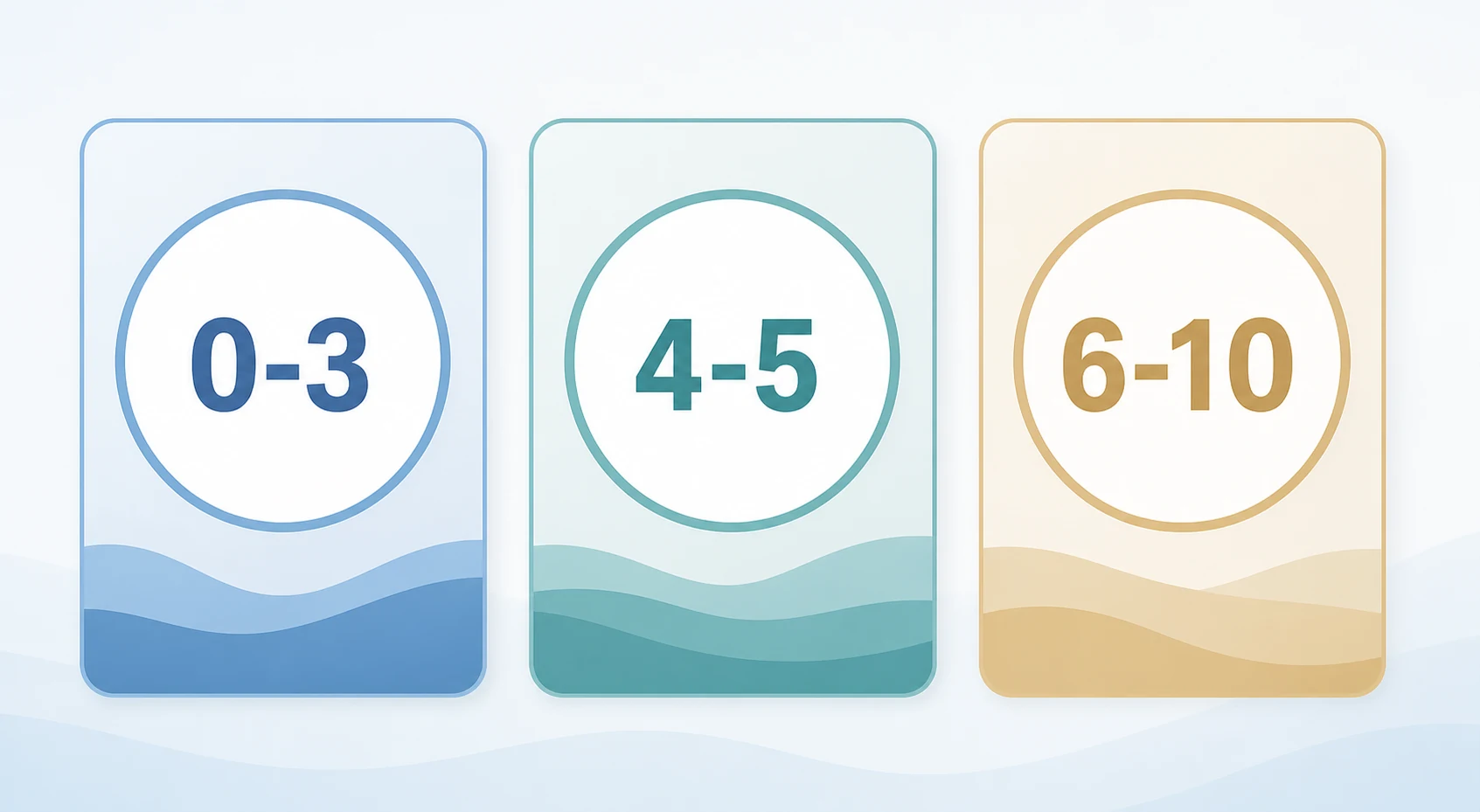
Here is a practical way to think about common score ranges:
- 0-3: fewer endorsed traits on this very brief screener.
- 4-5: near-threshold or mixed results that may deserve more context.
- 6-10: a higher result that may support further exploration, especially if traits have been consistent across life.
The middle range matters. A 4 or 5 can feel confusing because it is not clearly low and not clearly above the common cutoff. That does not mean the result is useless. It may mean the AQ-10 is too short to capture your experience cleanly, or that your answers depend heavily on the situation you had in mind while responding.
What a High AQ10 Score Can Mean
A higher AQ10 score means you endorsed more items in the autistic-trait direction. It can suggest that social communication, flexibility, attention patterns, sensory noticing, or interpretation of others' intentions may be worth exploring in more depth. It does not mean every trait is causing difficulty, and it does not say anything complete about your strengths, needs, history, or identity.
The most useful question after a higher score is not “What label does this number give me?” A better question is “Where do these patterns show up, and what do they cost or support in daily life?” For example, noticing small details may be a strength in some settings and exhausting in others. Preferring predictable routines may make life smoother, but sudden changes may require more recovery time.
If you use a free AQ screening experience, consider writing down two things after you see your result: which items felt immediately familiar, and which items were hard to answer because the wording depended on context. That short reflection can make the score more useful than the number alone.
Why a Low or Borderline Score May Still Deserve Context
Low AQ-10 results can be reassuring, but they do not erase lived experience. The AQ-10 is intentionally brief, so it may miss patterns that show up through masking, burnout, sensory overload, or internal effort rather than visible behavior. Some adults answer based on what they can perform, not how much energy that performance takes.
Borderline results are also common because traits are dimensional. A person may strongly relate to a few AQ-10 items and not relate to others. Another person may have learned scripts for social situations, which changes how they answer questions about ease, intention-reading, or conversation. Stress, anxiety, ADHD traits, trauma history, sleep problems, and major life transitions can also affect how a short screener feels on a given day.
This is why the AQ-10 works best as one data point. If your score feels inconsistent with your experience, do not rush to dismiss either one. Compare the result with examples from childhood, school, work, relationships, sensory environments, and periods of overwhelm. Patterns across time are usually more informative than a single testing moment.
Adult, Child, PDF, and Online Versions
Searchers often look for an AQ-10 questionnaire PDF for adults, an AQ-10 autism test PDF, or an AQ-10 child PDF. These formats can be useful when someone wants to print questions, bring notes to an appointment, or complete the screener away from a screen. Adult versions are self-report; child versions are typically completed by a parent or caregiver who knows the child's everyday behavior.
Online AQ10 tests are useful when you want fast scoring and fewer arithmetic mistakes. A well-designed online version should make the instructions clear, protect privacy, explain what the score can and cannot suggest, and avoid pressuring the user. A PDF can be easier to share with a professional; an online result can be easier to review immediately. The best choice depends on why you are using the screener.
For adults, it helps to answer based on your usual experience across time, not only on a very good day or a very stressful day. For children, caregivers should focus on consistent patterns across settings when possible, not one isolated incident. In both cases, the AQ-10 should open a careful conversation rather than close it.
How to Use Your Result Without Over-Interpreting It
Start by treating the AQ 10 test result as a map marker, not the whole map. A score can help you decide what to read, what to track, and what to discuss. It cannot capture your communication style, sensory profile, developmental history, co-occurring needs, culture, gendered expectations, or coping strategies in full.
Try a simple three-step review:
- Note the score range without attaching a verdict to it.
- List real-life examples that support or complicate the result.
- Decide whether a fuller self-assessment, professional conversation, or practical support strategy would be useful.
If you are considering an online psychiatric evaluation or a formal autism assessment, prepare examples rather than only bringing a score. Professionals often need information about early development, school experiences, social communication, sensory patterns, repetitive behaviors, daily functioning, mental health, and family context. The AQ-10 can be part of that preparation, but it is not the whole evidence base.
Also pay attention to strengths. Many people exploring autistic traits notice careful pattern recognition, deep focus, honest communication, unusual memory for details, or strong commitment to fairness. A supportive next step should help you understand both challenges and capacities.
A Supportive Next Step After the AQ 10 Test
After the AQ 10 test, the most grounded next step is to slow the process down enough to learn from it. If the score feels meaningful, compare it with a fuller questionnaire, journal examples for a week or two, or speak with a clinician who understands adult autism and neurodiversity. If the score feels low but your lived experience still raises questions, that is also valid information to explore.
You may also choose to review supportive AQ Test resources that frame screening as self-understanding rather than pressure. Look for tools that explain limitations clearly, protect your privacy, and encourage professional input when concerns affect your daily life.
The goal is not to force certainty from ten questions. The goal is to gather enough insight to make your next conversation, accommodation request, self-care plan, or professional appointment more informed and less overwhelming.

FAQ
What is a normal score on an autism test?
There is no universal “normal” score that applies to every autism screening tool. For the AQ-10, scores range from 0 to 10. Lower scores usually mean fewer endorsed traits on that specific screener, while scores around 6 or higher are often used as a signal that fuller assessment may be worth considering. The meaning depends on the tool, the person's age, and the wider context.
What does a high AQ10 score mean?
A high AQ10 score means more answers aligned with autistic-trait items on a short screener. It can suggest that deeper exploration may be useful, especially if the traits are long-standing or affect daily life. It does not provide a complete clinical answer by itself.
How do I know if I'm autistic?
Self-reflection tools can help you notice patterns, but a reliable answer usually requires broader information: developmental history, current traits, sensory experiences, communication patterns, daily support needs, and professional evaluation when appropriate. If the question matters to your wellbeing, support, or accommodations, consider discussing it with a qualified professional.
What is the mildest form of autism?
People sometimes use phrases like “mild autism” or “level 1 autism,” but support needs can vary widely by environment, stress, sensory load, and life stage. A person who appears outwardly independent may still be using significant effort internally. It is usually more respectful and useful to talk about specific strengths, challenges, and support needs.
Is the AQ-10 test for adults different from the child version?
Yes. The adult AQ-10 is generally a self-report screener for older teens and adults. Child versions are usually caregiver-report tools based on observations of the child's behavior. The questions, context, and interpretation should match the person's age and developmental stage.
Is an AQ-10 questionnaire PDF better than an online test?
Neither format is automatically better. A PDF can be useful for printing, saving notes, or bringing results to an appointment. An online version can reduce scoring errors and provide immediate feedback. The more important issue is whether the source explains scoring, privacy, and limitations clearly.
Can the AQ 10 test replace a professional evaluation?
No. The AQ-10 is a brief screener. It can support reflection and help you decide whether to seek more information, but a professional evaluation looks at much more than ten answers, including developmental history, current functioning, and overlapping conditions.