AQ Test for Adults: Understanding Autism & ADHD Overlap
Feeling a unique blend of traits that you can't quite pinpoint? Many adults wonder if their experiences align with autism, ADHD, or both. The journey of self-discovery often involves navigating a complex web of information, and the significant overlap between autism and adhd can make this process particularly confusing. Can I take the AQ test if I suspect I have ADHD? This is a common and important question for those seeking clarity. This guide will help untangle the intricate connection between these two neurotypes, exploring their common ground and key differences. By understanding your unique profile, you can take empowered steps forward, and tools like the AQ test can be a valuable starting point.
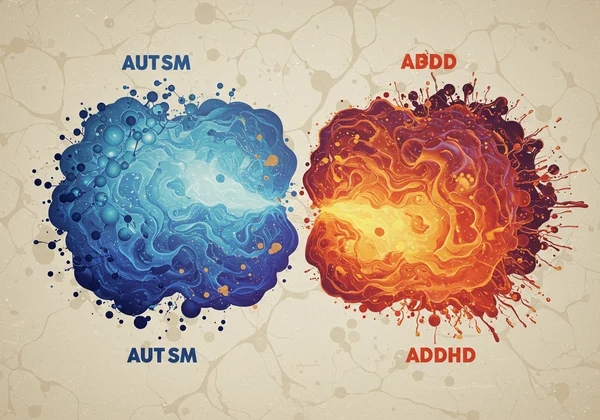
Understanding Core Neurodivergent Traits: Autism vs. ADHD Basics
Before diving into the similarities and differences, it's essential to have a foundational understanding of what autism and ADHD are, especially as they present in adults. Neurodiversity is a spectrum, and while clinical definitions provide a framework, individual experiences can vary widely.
What is Adult Autism Spectrum Disorder?
Autism Spectrum Disorder (ASD) in adults is a neurodevelopmental condition characterized by distinct patterns in social communication and interaction, alongside restricted or repetitive patterns of behavior, interests, or activities. For many autistic adults, this can manifest as a preference for direct, literal communication, difficulty interpreting subtle social cues, and a deep need for routine and predictability. They often have intense, specialized interests and may experience heightened or diminished sensitivity to sensory input like sounds, lights, or textures.
What is Adult Attention-Deficit/Hyperactivity Disorder?
Attention-Deficit/Hyperactivity Disorder (ADHD) in adults is another neurodevelopmental condition, primarily affecting the brain's executive functions. This leads to persistent patterns of inattention, hyperactivity, and impulsivity that interfere with daily functioning. Adult symptoms can look different from those in childhood; hyperactivity might present as inner restlessness, while inattention can lead to challenges with organization, time management, and completing tasks. Impulsivity can affect decision-making and emotional responses.
The Overlapping Landscape: Common Similarities Between Autism and ADHD
The reason so many adults question if they have one, the other, or both is because autism and ADHD share a surprising number of traits. This overlap can make self-assessment tricky without the right information.
Shared Executive Function Challenges
Executive functions are the high-level mental processes that help us plan, focus, remember instructions, and manage multiple tasks. Both autistic adults and those with ADHD often face significant challenges in this area. This can look like difficulty starting a project (task initiation), struggling to stay organized, poor time management, or finding it hard to switch between tasks. While the underlying reasons may differ, the outward struggle is remarkably similar, impacting work, home life, and relationships.

Intense Interests and Hyperfocus
Both neurotypes can experience a state of intense concentration known as hyperfocus. When engaged in a topic of great interest, an autistic person or an individual with ADHD can become so absorbed that the world around them fades away. For autistic individuals, this often ties into deep, long-lasting special interests. For those with ADHD, hyperfocus can be a powerful tool for productivity on novel or stimulating tasks, though interests may shift more frequently. This shared ability to focus deeply can be a significant strength. Exploring these traits with an autism spectrum test can offer valuable perspective.
Sensory Sensitivities and Emotional Dysregulation
Processing the world can feel intense for both autistic people and individuals with ADHD. Sensory sensitivities are common, whether it's being overwhelmed by loud noises (hyper-sensitivity) or craving strong sensory input (hypo-sensitivity). Similarly, emotional dysregulation—difficulty managing the intensity and duration of emotional responses—is a core feature of both conditions. A seemingly small frustration can trigger a disproportionately large emotional reaction, leading to feelings of being out of control or emotionally exhausted.
Key Differences: Distinguishing Autism from ADHD Symptoms in Adults
Despite the overlaps, there are crucial distinctions that help differentiate autism from ADHD. Understanding these differences is key to gaining a clearer picture of your own neurotype. The core motivations and internal experiences behind similar behaviors are often where the distinction lies.
Varied Social Communication and Interaction Styles
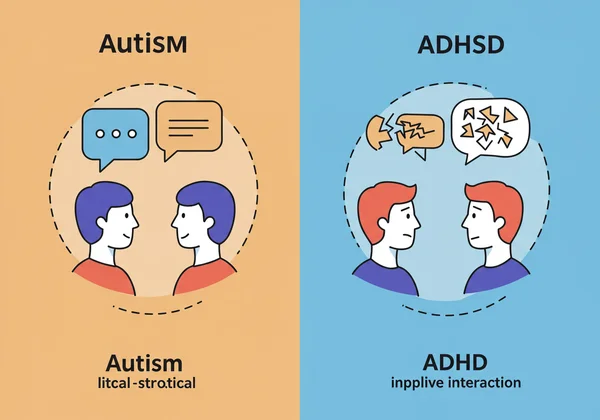
This is one of the most significant differentiating areas. An autistic person's social challenges often stem from a different way of processing social information. They may struggle to intuitively grasp non-verbal cues, prefer literal language, and find social "small talk" draining. The desire for social connection is often present, but the "how" can be the difficult part. Conversely, an adult with ADHD might struggle socially due to impulsivity (interrupting others), inattention (drifting during conversations), or emotional dysregulation, not necessarily a fundamental difficulty in interpreting social rules.
Repetitive Behaviors and Restricted Interests
A core characteristic of autism involves a preference for sameness and routine. This can manifest as repetitive physical movements known as "stimming" (e.g., hand-flapping, rocking) which serve a self-regulatory purpose. Autistic individuals often find immense comfort in predictability and may become distressed when routines are disrupted. For ADHD, repetitive behaviors are more likely to be fidgeting to maintain focus or release excess energy. While they can have intense interests, individuals with ADHD often crave novelty and may become bored with routine.
Motivations Behind Attention and Focus Challenges
How and why attention is challenging also differs. For an autistic person, attention might be difficult to shift away from a special interest or an internal thought process. Distraction can also come from being overwhelmed by sensory input, making it hard to filter out irrelevant information. For an individual with ADHD, the challenge is often in sustaining attention, especially on tasks that are not inherently stimulating or rewarding. Their attention is more easily pulled away by external distractions or new, more interesting ideas. Understanding your specific pattern of attention can be a major clue, and an initial online autism screening may help highlight these traits.
Navigating Your Journey: How the AQ Test Can Offer Insights
Untangling these complex threads is a personal journey. While this guide offers clarity, a practical tool can provide a more concrete data point for your self-exploration. The Autism Spectrum Quotient (AQ) test is a screening questionnaire designed to measure the degree to which an adult has autistic traits.
Using Your AQ Score for Self-Reflection
Taking a free AQ test online provides you with an immediate score. This score isn't a diagnosis, but it is a valuable piece of information. If you suspect ADHD but score high on the AQ test, it could suggest that you have a significant number of autistic traits. This might mean you are autistic, you are both autistic and have ADHD, or your ADHD presentation shares many features with autism. This is where the personalized AI report from our platform becomes invaluable, going beyond a simple score to help you understand your unique profile of strengths and challenges. Getting your AQ score is a confidential and insightful first step.

When to Consider Professional Assessment for Neurodiversity
It is crucial to remember that the AQ test and other online screeners are not diagnostic tools. They are designed to be informative guides for self-reflection. If your results and research resonate deeply, the next step is to consult a qualified healthcare professional, such as a psychologist or psychiatrist. They can conduct a comprehensive diagnostic evaluation for both autism and ADHD, consider your full history, and provide an accurate diagnosis. Your AQ test results can be an excellent starting point for that conversation.
Taking Your Next Steps: Embracing Your Neurodivergent Profile
Understanding the intricate relationship between autism and ADHD in adults is a powerful step toward self-awareness and self-acceptance. By recognizing the overlaps and appreciating the key differences, you empower yourself with the knowledge to better navigate your world. This journey is not about fitting into a box but about understanding your unique operating system.
Begin your journey of self-discovery today. Take the free AQ Test and unlock deeper insights with an optional, AI-powered personalized report. It's a confidential, accessible first step toward understanding your unique neurodivergent profile.
Common Questions About Autism, ADHD, & the AQ Test
Can I take the AQ test if I suspect I have ADHD?
Absolutely. Many people with ADHD take the AQ test to see if their traits align with the autism spectrum. Since there is significant overlap, the results can help clarify whether your experiences are more indicative of autism, ADHD, or a potential co-occurrence of both.
Is the AQ test a diagnosis for autism or ADHD?
No. It is very important to understand that the AQ test is a screening tool, not a diagnostic instrument. It specifically measures autistic traits and cannot diagnose either autism or ADHD. A formal diagnosis can only be provided by a qualified healthcare professional after a comprehensive assessment.
What does a high AQ test score mean if I also have ADHD symptoms?
A high AQ score indicates that you possess a significant number of traits commonly associated with autism. If you also identify with ADHD symptoms, this could suggest several possibilities: you may be autistic, you may have both autism and ADHD, or your ADHD presents in a way that shares many characteristics with autism. Your score from the AQ test online is a valuable data point for further exploration with a professional.
How accurate is the AQ test for adults with co-occurring conditions?
The AQ test is well-regarded for its accuracy in identifying autistic traits as developed by researcher Simon Baron-Cohen. However, it is not designed to differentiate these traits from similar ones that might be caused by another condition like ADHD. Therefore, while it accurately flags the presence of autistic traits, it cannot provide a differential diagnosis. It serves as an effective initial screening to guide further, more comprehensive evaluation.