AQ Test Results: How to Discuss Your Online Autism Screening Score with Your Doctor
Embarking on the journey of self-discovery by taking an online Autism Spectrum Quotient (AQ) test is a brave and significant step. You’ve taken the time to answer the questions, received your score, and perhaps even explored your AI-generated personalized report. Now, you might be standing at a crossroads, wondering what comes next. For many, the next step involves discussing aq test with doctor results to gain further clarity. But how can you turn your online test results into a productive, empowering conversation about your well-being?
This guide is designed to walk you through that process. Approaching a healthcare professional with self-gathered information can feel daunting, but with the right preparation, it can be an incredibly positive and validating experience. Let’s explore how to use your AQ test results as a powerful tool to advocate for your health and understanding. If you haven't taken the test yet, you can get your AQ score to begin your journey.

Preparing to Talk to Your Doctor About Your Online Autism Screening
A successful conversation begins long before you step into the doctor's office. Thoughtful preparation will help you feel more confident and ensure you can clearly communicate your experiences and concerns. Think of this as building a bridge between your personal insights and your doctor’s professional expertise.
Gathering Key Observations & Experiences
Your AQ score is a data point, but your life experiences are the story. A doctor will be most interested in how your traits manifest in your daily life. Before your appointment, take some time to reflect and jot down specific examples related to the areas the AQ test assesses, such as social skills, communication, imagination, attention to detail, and tolerance for change.
Consider questions like:
- In what specific social situations do I feel drained or confused?
- Do I often miss subtext or take things too literally in conversations?
- Do I have intense, focused interests that I can talk about for hours?
- How do I react to unexpected changes in my routine?
- Do certain sensory inputs (like bright lights, strong smells, or specific sounds) overwhelm me?
Having concrete examples makes your concerns tangible and provides your doctor with valuable clinical information that a score alone cannot convey.
Your AQ Score and Personalized Insights
This is where your results from your online AQ test become particularly useful. Don't just show up with a number. If you opted for the AI-powered analysis, print it out or have it ready on your phone. This report is designed to translate your score into meaningful insights about your unique strengths and potential challenges.
Highlight sections of your personalized report that resonate with you. For instance, you could say, "My report pointed out a strong aptitude for pattern recognition, which makes sense because of my career in data analysis. However, it also noted potential challenges in social communication, and here are some examples of that in my life..." This approach frames the test not as a self-diagnosis but as an organized starting point for a deeper conversation.

Having the Conversation: Effective Strategies
With your notes and report in hand, you’re ready for the conversation itself. The goal is not to convince your doctor you are autistic but to collaborate with them to explore your experiences and determine the best path forward.
Framing Your Concerns Clearly
How you begin the conversation sets the tone. Avoid leading with "I think I have autism." Instead, start with your observations and use the AQ test as a tool that prompted your reflection.
Try an opening like one of these:
- "I've been exploring some aspects of my social and sensory experiences, and I recently took a well-regarded screening tool called the AQ test online. The results were interesting, and I was hoping we could discuss them and what they might mean."
- "I’ve always felt a bit different in social situations, and I wanted to understand why. I took the AQ test to get some insight, and it brought up some points I'd like to talk through with you."
This approach is non-confrontational and invites your doctor into your process of inquiry. It shows that you are being thoughtful and are seeking their professional guidance, not just a specific label.

Essential Questions to Ask Your Doctor
Remember, your consultation is a collaborative effort. Preparing a list of questions can empower you to get the clarity and information you need. This demonstrates that you are an engaged participant in your own healthcare.
Consider asking:
- Based on what I've shared, what are your initial thoughts?
- What is the standard autism assessment process for adults in this area?
- Could you refer me to a specialist, like a psychologist or psychiatrist, who has experience with adult autism diagnoses?
- Are there any other possibilities we should consider that could explain my experiences?
- What resources or support systems would you recommend I look into while I explore this further?
These questions can help guide the conversation toward actionable next steps, whether that's a referral for a formal evaluation or exploring other avenues.
Understanding Next Steps for an Adult Autism Diagnosis After Your AQ Score
The conversation with your doctor is often the first step in a longer process. It’s important to manage your expectations and understand what might come next if you choose to pursue a formal assessment for getting an adult autism diagnosis.
Navigating the Adult Diagnostic Process
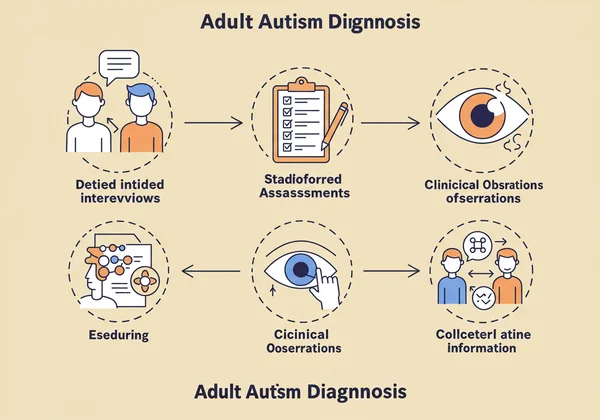
A formal diagnosis is not made from a single conversation or screening tool. If your doctor agrees that an evaluation is warranted, they will likely refer you to a specialist. The diagnostic process for adults is comprehensive and can include:
- Detailed Interviews: Discussing your developmental history from childhood to the present.
- Clinical Observations: The specialist will observe your communication style and social interactions during the appointment.
- Standardized Assessments: You may be asked to complete more in-depth questionnaires or specific diagnostic tools like the ADOS-2.
- Collateral Information: Sometimes, the clinician may ask for input from a parent, partner, or close friend who has known you for a long time.
This process is thorough for a reason: to ensure an accurate and helpful outcome.
What If Your Doctor Is Skeptical or Unfamiliar?
It's a reality that some primary care physicians may have limited training in adult autism, especially in how it can present differently from childhood autism or in women. If you feel your concerns are being dismissed, try not to get discouraged.
You can calmly say, "I understand that adult autism is a complex area. Could you still provide a referral to a specialist for a more detailed evaluation? I would feel more comfortable having an expert assess this." If they are unwilling, it is perfectly acceptable to seek a second opinion from another doctor. Your self-understanding is worth advocating for. Remember, the goal is to find a healthcare partner who will support you on your journey.
Empowering Your Journey to Self-Understanding
Discussing your AQ test results with a doctor is a courageous step toward greater self-awareness. It’s about transforming curiosity into a constructive conversation. By preparing your thoughts, using your AQ score and report as a guide, and asking informed questions, you can navigate this process with confidence.
The AQ test is a starting point—a key that unlocks a door. What lies beyond is a path of discovery that you can walk with the support of informed professionals. Whether it leads to a formal diagnosis, new coping strategies, or simply a deeper appreciation for your own unique neurotype, it is a journey worth taking. Ready to take the first step? Start your journey today.
Frequently Asked Questions About AQ Test & Diagnosis
Is the AQ test a diagnosis for autism?
No, it is absolutely not. The AQ test is a valuable screening tool designed to measure autistic traits in adults. It indicates whether you have a higher or lower number of these traits compared to the general population. A formal diagnosis can only be made by a qualified healthcare professional through a comprehensive clinical evaluation.
What should I do after getting my AQ score?
After receiving your score, take time to reflect on it. We highly recommend exploring the AI-powered personalized report offered on our site, as it provides context beyond the number. You can use these insights for personal reflection, to find supportive online communities, or as a structured starting point for a conversation with a therapist or doctor, as outlined in this article.
What is the difference between the AQ test and a clinical diagnosis?
The AQ test is a self-report questionnaire that provides a score based on your answers. It's a snapshot of your traits. A clinical diagnosis is an in-depth, multi-faceted process conducted by a trained professional. It involves interviews, behavioral observations, and a review of your developmental history to determine if you meet the specific criteria for Autism Spectrum Disorder (ASD) as defined in diagnostic manuals like the DSM-5.
How accurate is the AQ test when discussing with a doctor?
The AQ test is a scientifically validated and widely used screening instrument developed by researchers at Cambridge University. Its accuracy lies in its ability to identify autistic traits. When presented to a doctor, it serves as credible, evidence-based documentation of your self-assessment and a strong reason to explore your concerns further. It provides a solid foundation for beginning the diagnostic conversation. You can take the free test on our homepage.