Are Online Autism Tests Accurate: A Guide to Self-Discovery
If you find yourself wondering, "are online autism tests accurate," you are likely on a deeply personal journey seeking clarity about your unique mind. Many adults find that using an autism spectrum quotient test online provides a much-needed vocabulary for experiences they previously couldn't explain. In this guide, we will explore the reliability of digital screening, provide a checklist for interpreting your scores, and explain how to use these tools effectively to gain a clearer path toward self-understanding.
The Science of Screening: How Online Autism Tests Work
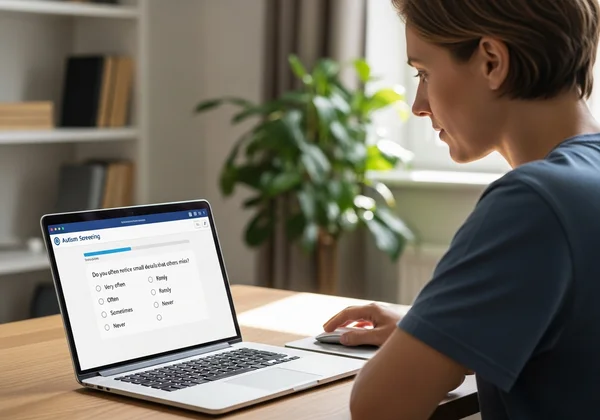
To understand if are online autism tests accurate, we must first look at the psychological framework they use. Most reputable online tools are based on psychometric questionnaires like the Autism Spectrum Quotient (AQ-50) or the RAADS-R. These are not "buzzfeed-style" quizzes; rather, they are scientifically developed instruments designed to measure specific autistic traits in adults.
Researchers developed these questions to identify patterns in social communication, imagination, and attention to detail. When you take a good online autism test, the algorithm calculates your responses against a weighted scale. For instance, the AQ-50 focuses on five distinct areas: social skills, attention switching, communication, imagination, and attention to detail. These tools function as a sophisticated "mirror," reflecting your behavioral tendencies back to you through a clinical lens.
Are These Tests Legitimate? Understanding Screening vs. Diagnosis
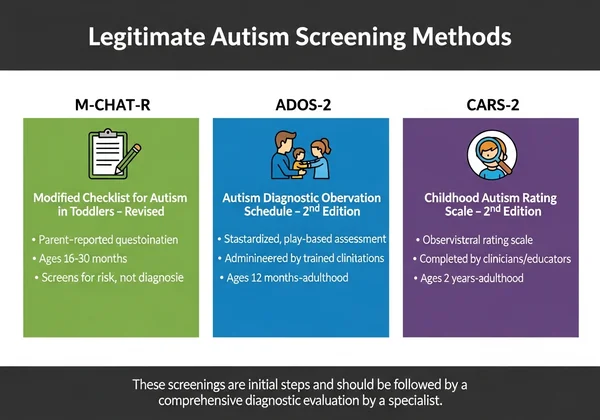
One of the most frequent questions we hear is: is there a legitimate online test for autism that counts as a medical record? The short answer is no. There is a fundamental legal and medical distinction between "screening" and "diagnosis" that every user must understand.
Screening Tools
- Purpose: To identify individuals who may need a more thorough evaluation.
- Accessibility: Usually available online and can be completed in 10–20 minutes.
- Outcome: A score indicating a "likelihood" of being on the spectrum.
Diagnostic Assessments
- Purpose: To provide a formal medical conclusion for clinical support or accommodations.
- Accessibility: Conducted by a licensed psychologist or psychiatrist over several hours or sessions.
- Outcome: A formal clinical report that is legally recognized by schools, employers, and healthcare systems.
While accurate autism assessment requires a professional, online screening is an essential first step. It acts as a filter. If you score below the threshold, you might explore other explanations for your traits, such as social anxiety. If you score above it, you have a solid foundation of data to bring to a professional evaluation.
Factors Influencing Your Results: Why Accuracy Matters
Even when using a high-quality tool, several factors can influence the question: how accurate are online autism tests for adults? Because these are self-report measures, the results depend heavily on your own self-perception and honesty.
One major factor is "masking." Masking is the subconscious process where neurodivergent individuals learn to mimic neurotypical behaviors to fit in. If you have spent decades masking, you might answer questions based on how you behave in public rather than how you feel internally. This can lead to a score that is lower than it should be.
Furthermore, your current mental state matters. If you are experiencing high levels of burnout or depression, you might perceive your social struggles as more severe than they are in a baseline state. To get the most accurate autism assessment, try to answer based on your "inner child"—the person you are when you are completely alone and unobserved.
Beyond the Score: Why a Deep Analysis Matters
A simple number, such as a 35/50 on an AQ test, can be validating, but it often leaves you with more questions than answers. To truly understand your neurodivergent traits, you need to know why you scored that way.
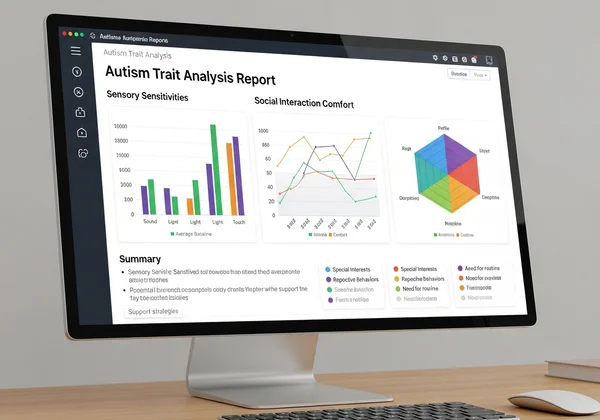
At Aqtest.org, we believe that self-discovery should be a deep dive. Our AI-driven personalization helps you by breaking down your results into manageable themes. Instead of just seeing a number, you receive an analysis of how your sensory processing, social communication, and cognitive patterns interact. This deeper level of information is incredibly valuable when you decide to take the next step toward professional support.
Common Misdiagnoses: What Else Could It Be?
While you are investigating if are online autism tests accurate, you must also consider "differential diagnosis." Autism shares many traits with other conditions. This overlap is why professional diagnosis is so complex and why online tests can sometimes be misleading if taken in isolation.
Common conditions that overlap with Autism include:
- ADHD: Many people are "AuDHD." Both conditions involve executive dysfunction and sensory issues.
- Social Anxiety Disorder: Both involve avoiding social situations, but for different reasons (fear vs. communication differences).
- Sensory Processing Disorder (SPD): You may have intense sensory reactions without the specific social communication differences of autism.
Before finalizing your self-understanding, it is helpful to explore our autism symptoms checklist to see how these traits manifest in daily life. Understanding the nuance between these conditions ensures you are looking at the whole picture of your mental health.
Actionable Tool: Your Self-Assessment Readiness Checklist
To ensure you are approaching your online screening with the right mindset, follow this "Ready-to-Test" checklist:
- Environment Check: Are you in a quiet, safe space where you won't be interrupted?
- Mindset Check: Are you prepared for any result? A low score doesn't mean your struggles aren't real.
- Honesty Check: Are you answering based on your internal reality or your "masked" public persona?
- Context Check: Do you have examples from your childhood? Autism is a developmental condition.
- Action Plan: Do you have a plan for after the test? Whether the result is high or low, what is your next step for self-care?
How to Talk to a Professional About Your Results
Many people feel anxious about bringing an online test score to a doctor. To make this easier, here is a simple script you can use to start the conversation:
"I’ve been reflecting on some of my lifelong social and sensory patterns lately. To organize my thoughts, I took a scientifically-backed online screening tool called the AQ-50. My results indicated a high probability of autistic traits, particularly in [mention a specific area like sensory or social]. I’d like to discuss these results with you and see if a formal clinical assessment is a logical next step."
Bringing a printed copy of your detailed report can also help the professional see that you have done your research and are seeking clarity rather than a "quick label."
Using Online Tests as a Tool for Empowerment
Ultimately, the answer to "are online autism tests accurate" is that they are highly reliable as screening tools but not as diagnostic ones. They are the beginning of a journey, not the destination. Self-knowledge is power. Whether you are seeking a formal diagnosis or simply looking for peace of mind, these tools offer a way to validate your lived experience.
If your results suggest you are on the spectrum, embrace that information as a tool for self-accommodation. When you are ready, you can check your traits with this autism spectrum quotient test to see how your unique cognitive profile fits into the broader neurodivergent community.

Frequently Asked Questions
Which online autism test is the most accurate?
The most reliable and widely used online screening tools are the AQ-50 (Autism Spectrum Quotient) and the RAADS-R. These are used by clinicians worldwide as initial screening instruments because they have undergone significant academic peer review.
Can a formal autism assessment be done online?
Yes, but only if it is conducted by a licensed clinical professional via telehealth. An automated questionnaire is a screening tool, whereas a "virtual diagnosis" involves a live video evaluation with a psychologist using standardized protocols.
What is the "6-second rule" for autism often mentioned online?
The "6-second rule" is a social observation suggesting that some neurodivergent individuals may take longer (up to 6 seconds) to process a question and formulate a response. While not a formal diagnostic criterion, it describes common auditory processing differences.
What does "chinning" mean in the context of autism behaviors?
"Chinning" is a term used to describe a specific type of sensory-seeking behavior or "stim" where an individual presses their chin against objects or surfaces. It provides grounding tactile and vestibular input that many autistic individuals find calming.
What are the primary factors or causes behind autism?
Autism is widely understood as a complex neurodevelopmental condition influenced by a combination of genetic and environmental factors. Current research focuses on brain connectivity and development, rather than a single cause.