Assessing Autism Spectrum Disorder: From Initial Screening to Clinical Diagnosis
Navigating the journey of understanding neurodivergence can often feel overwhelming, especially when faced with conflicting information and complex medical terms. You might be questioning whether certain lifelong traits, social challenges, or sensory sensitivities point towards being on the autism spectrum. This uncertainty is a common and valid starting point for many adults seeking answers.
This guide is designed to clarify the process of assessing autism spectrum disorder, breaking it down into manageable steps. We will explore the official criteria professionals use, explain the crucial difference between a simple screening and a formal diagnosis, and guide you on how to start exploring your traits safely. Whether you are looking for medical confirmation or simply want to check your traits with an autism test online, knowing how assessment works is the first step toward clarity.

What Does Assessing Autism Spectrum Disorder Involve?
When people search for information on assessing autism spectrum disorder, they often wonder if there is a single, quick test that provides a definitive "yes" or "no." The reality is more nuanced. Unlike conditions diagnosed with a simple blood test or X-ray, assessing autism is a comprehensive process that evaluates behavior, developmental history, and current functioning.
A Multidisciplinary Approach: More Than Just a Checkup
A professional autism spectrum disorder assessment is rarely a one-hour appointment. It typically involves a team of specialists or a highly trained clinician who looks at the "whole person." This multidisciplinary approach ensures that the assessment captures the complexity of how you interact with the world.
Clinicians aim to differentiate autism from other conditions that might look similar, such as ADHD, anxiety, or sensory processing disorders. The goal is not just to label a set of behaviors but to understand the underlying reasons for your experiences.
Key Components: Interviews, History, and Observation
A thorough evaluation process generally includes three main pillars:
- Clinical Interviews: These are in-depth conversations about your life, current challenges, and strengths.
- Developmental History: Since autism is a developmental condition, clinicians need to understand your early years. They may ask to speak with parents or review childhood records to see if traits were present early on.
- Direct Observation: Tools like the ADOS-2 (Autism Diagnostic Observation Schedule) allow professionals to observe how you communicate and respond in social situations in real-time.
The Criteria: Understanding the DSM-5 Standards
To ensure consistency, professionals in many countries rely on the Diagnostic and Statistical Manual of Mental Disorders, Fifth Edition (DSM-5). This manual outlines the specific criteria required for a diagnosis. Understanding dsm5 asd standards can help you see what clinicians are looking for during an assessment.
Domain A: Social Communication & Interaction
The first major category focuses on how you connect with others. To meet the criteria for autism, persistent deficits in social communication must be present across multiple contexts.
- Social-Emotional Reciprocity: This might look like difficulty with back-and-forth conversation or sharing interests and emotions with others.
- Nonverbal Communication: Challenges might include understanding gestures, maintaining eye contact, or reading facial expressions.
- Relationships: This involves difficulties in developing, maintaining, and understanding relationships, such as adjusting behavior to suit different social contexts.
Domain B: Restricted & Repetitive Behaviors
The second category involves restricted, repetitive patterns of behavior, interests, or activities. At least two of the following asd symptoms must be present:
- Repetitive Movements: Stereotyped motor movements (like hand flapping), use of objects, or speech (echolalia).
- Insistence on Sameness: Inflexible adherence to routines, ritualized patterns of verbal or nonverbal behavior, or extreme distress at small changes.
- Fixated Interests: Highly restricted, fixated interests that are abnormal in intensity or focus.
- Sensory Sensitivities: Hyper- or hyporeactivity to sensory input, such as adverse responses to specific sounds or textures.
Understanding Severity Levels (1, 2, and 3)
The DSM-5 also classifies autism by severity levels based on the amount of support required:
- Level 1: Requires support. (Often previously associated with Asperger's or "high-functioning" autism).
- Level 2: Requires substantial support.
- Level 3: Requires very substantial support.
Screening vs. Diagnosis: Knowing the Difference
One of the most critical distinctions to understand is the difference between screening and diagnosis. Confusing the two can lead to false expectations or unnecessary anxiety.
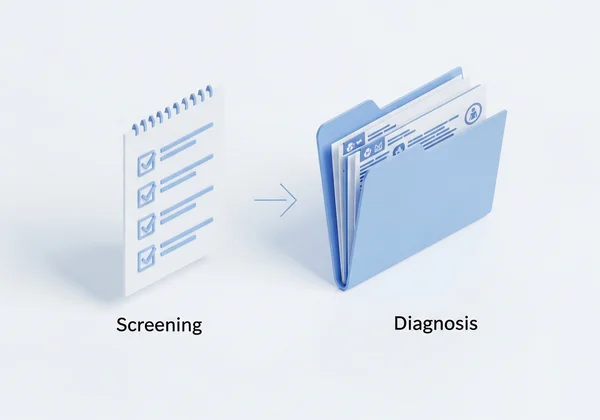
The Role of Screening: Identifying Traits and Risks
Autism screening is a preliminary step. It uses brief, validated questionnaires to identify whether you have traits consistent with the autism spectrum.
- Purpose: To flag potential red flags or high-risk traits.
- Outcome: A score indicating the likelihood of being on the spectrum.
- Provider: Can be done online at sites like Aqtest.org, or by a GP or counselor.
- Action: Helps you decide if a full evaluation is warranted.
Screening tools are accessible and often free. They are excellent for "self-discovery" and validating your experiences but cannot provide a medical label.
The Role of Diagnosis: Formal Clinical Confirmation
A formal diagnosis is a medical conclusion reached after the comprehensive evaluation described earlier.
- Purpose: To provide a definitive medical confirmation of Autism Spectrum Disorder.
- Outcome: A formal report and diagnosis (e.g., ASD Level 1).
- Provider: Only qualified specialists (psychologists, psychiatrists, neurologists).
- Action: Opens doors to formal support services, accommodations, and legal protections.
The First Step: Using Screening Tools for Self-Discovery
If you relate to the DSM-5 criteria but aren't ready for a clinical evaluation, starting with self-reflection is a powerful first step. You don't need a doctor's appointment to begin understanding your own mind.
Why Start with Self-Reflection?
For many adults, the realization that they might be autistic comes slowly. Using screening tools allows you to explore your traits in private, at your own pace. It can validate feelings of being "different" that you may have held for decades.
Introducing the Autism Spectrum Quotient (AQ)
One of the most widely respected tools for this purpose is the Autism Spectrum Quotient (AQ). Developed by psychologists at Cambridge University, it is designed to measure the extent of autistic traits in adults with normal intelligence.
Get Insights, Not Just a Score
While a raw score is helpful, understanding why you scored that way is better. Modern tools can analyze your answers to provide insights into specific areas like social skills, attention switching, and communication.
If you are curious about where your traits lie, you might want to explore our autism test online to get a personalized report. This isn't a medical diagnosis, but an educational resource to help you map your unique profile.
Specific Challenges in Assessing Adults
If you are seeking an adult autism assessment, you may face hurdles that children do not. The diagnostic criteria were originally developed with children in mind, and adults often present differently due to years of adaptation.
The Phenomenon of "Masking" or Camouflaging
Many autistic adults, especially women and those with low support needs, develop coping mechanisms known as "masking." This involves consciously or unconsciously suppressing autistic behaviors to fit in socially.
- Forcing eye contact even when it's uncomfortable.
- Scripting conversations before they happen.
- Mimicking the gestures and expressions of others.
Masking autism can make it difficult for clinicians to spot traits during a standard observation. This is often discussed in the context of autism in women, where camouflaging social difficulties is particularly common, leading to missed diagnoses.
Retrospective History: Why Childhood Memories Matter
Because autism is developmental, a diagnosis requires evidence that traits were present in early childhood. For adults, this means relying on memory or the accounts of aging parents. If childhood records are unavailable, this part of the assessment can be challenging but is crucial for accuracy.
Co-occurring Conditions: Distinguishing ASD from ADHD/Anxiety
It is common for undiagnosed autistic adults to be treated for anxiety, depression, or ADHD first. These conditions often co-occur with autism, or symptoms may overlap. A skilled clinician must tease apart what is anxiety, what is ADHD, and what is the underlying neurotype of autism.
Professional Tools Used in Clinical Settings
If you decide to proceed with a formal autism spectrum disorder assessment, you will likely encounter specific standardized tools. These are "gold standard" instruments designed to reduce subjectivity.

Standardized Observation (ADOS-2)
The Autism Diagnostic Observation Schedule, Second Edition (ADOS-2) is a semi-structured assessment of communication, social interaction, and play (or imaginative use of materials) for individuals suspected of having autism. For adults, it involves a series of conversation-based activities that press on social "weak spots" to see how you respond.
Clinical Interviews (ADI-R)
The Autism Diagnostic Interview-Revised (ADI-R) is a comprehensive interview typically conducted with a parent or caregiver. It focuses on your developmental history to establish if symptoms were present in the early years, which is essential for a DSM-5 diagnosis.
Finding a Qualified Professional
Not all mental health professionals are trained to diagnose autism, especially in adults.
- Psychologists: Often conduct the most comprehensive behavioral assessments.
- Psychiatrists: Can diagnose and are particularly helpful if medication for co-occurring conditions (like anxiety) is needed.
- Neurologists: Focus more on the brain's physical function and ruling out other neurological issues.
When seeking an evaluation, always ask: "Do you have specific experience with assessing autism spectrum disorder in adults?"
Moving Forward with Confidence
The journey of assessing autism spectrum disorder is deeply personal. For some, a formal diagnosis provides necessary validation and access to support. For others, self-identification and understanding their traits through screening tools are enough to improve their quality of life.
Remember, a diagnosis doesn't change who you are; it simply provides a map to understand yourself better. Whether you choose to pursue a clinical evaluation or simply explore your traits privately, the goal is self-awareness.
If you are just starting this journey and want a safe, commitment-free way to explore your neurotype, consider checking your traits with our autism spectrum test. It can provide a helpful baseline as you decide on your next steps.
Frequently Asked Questions
How long does a formal autism assessment take?
A comprehensive evaluation is time-intensive. It often involves multiple appointments, totaling several hours of interviews, testing, and feedback sessions. The entire process, from intake to final report, can span several weeks.
Is it ever too late to be assessed for autism spectrum disorder?
No, it is never too late. Many people are diagnosed in their 30s, 40s, 50s, and beyond. Understanding your neurotype at any age can bring immense relief and help explain lifelong challenges.
How reliable are online autism screening tools?
Validated tools like the AQ (Autism Spectrum Quotient) provided by platforms like Aqtest.org are generally reliable for identifying traits associated with autism. However, they are screening instruments, not diagnostic tools. A high score suggests a high likelihood of being on the spectrum but does not confirm it medically.
Is an autism assessment covered by insurance?
This varies significantly by region and insurance plan. In the US, many insurers cover assessments for children but coverage for adults can be spotty. It is essential to call your provider and ask specifically about coverage for "adult autism psychological testing."
Is there a blood test or brain scan for autism?
Currently, there are no biological tests (like blood work or MRI scans) that can diagnose autism. Assessment relies entirely on behavioral observation, clinical interviews, and developmental history.