What Is the AQ-10 Test? A Quick Screening Tool for Autistic Traits in Adults
Discovering your unique neurodivergent traits as an adult can feel like piecing together a lifelong, complex puzzle. Many individuals begin this process by searching for accessible, scientifically validated tools that provide clarity without clinical pressure. If you are exploring your own cognitive patterns, you have likely encountered the Autism-Spectrum Quotient (AQ) framework. This comprehensive guide breaks down the aq10 test, a rapid 10-question screening instrument recommended by national healthcare systems to help individuals recognize their behavioral traits. By understanding how this brief questionnaire operates, you can use our online AQ-10 framework to initiate a safe, compassionate journey of self-discovery at your own pace.

What is the AQ-10 Test? Origins and Its Role in the NHS Framework
The Autism-Spectrum Quotient-10, commonly referred to as the AQ-10, is a brief self-assessment questionnaire derived from the original 50-item AQ scale. Developed by Professor Simon Baron-Cohen and his team at the Cambridge Autism Research Centre, this streamlined version was engineered to improve the efficiency of initial autism screenings in mature individuals.
In contemporary medicine, time is often a barrier to care. Recognizing this, the National Institute for Health and Care Excellence (NICE) in the United Kingdom formally integrated the aq10 test nhs recommendations into their clinical pathways. The primary purpose of the aq10 test is to act as an initial filtering mechanism for general practitioners. Instead of subjecting every questioning individual to an immediate, hours-long neurodevelopmental evaluation, healthcare providers utilize this ten-question scale to determine if a formal referral is justified. It serves beautifully as an accessible, open-access autism screening tool that bridges the gap between private self-reflection and professional medical consultation.
AQ-10 vs. AQ-50: Comparing the Brief Assessment and the Full Autism Test
When exploring online resources, many individuals find themselves confused by the various verasions of the Autism-Spectrum Quotient. The fundamental distinction between the alternative formats lies in their clinical scope, response burden, and operational intent.
The full-length AQ-50 consists of fifty detailed inquiries covering a broad range of behavioral variations, typically requiring fifteen to twenty minutes to complete. While the AQ-50 offers a comprehensive look at an individual's trait profile, its length can sometimes cause cognitive fatigue or anxiety during self-reflection. Conversely, the AQ-10 distills these items down to the ten most statistically powerful questions, optimizing for speed and clarity.
| Comparative Features | The Short-Form AQ-10 | The Full-Length AQ-50 |
|---|---|---|
| Primary Focus | Rapid screening and referral guidance | Multi-dimensional trait mapping |
| Completion Time | Approximately 2 minutes | 15 to 20 minutes |
| Total Questions | 10 items | 50 items |
| Institutional Use | Highly favored in GP front-line triage | Utilized in deeper clinical intake |
| Ideal Starting Point | Initial self-awareness check | Secondary structured self-review |
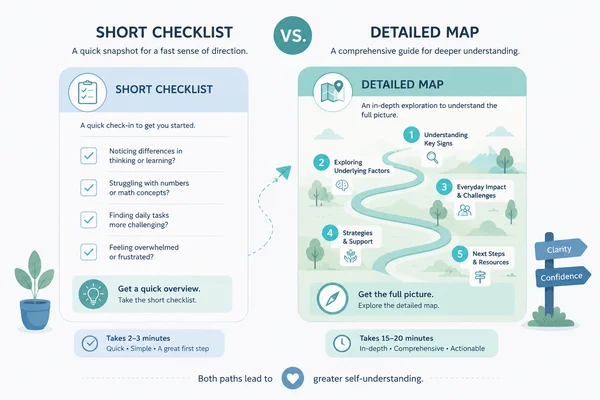
For individuals seeking a physical document to review in a quiet, analog setting, obtaining an aq-10 pdf or structured aq-10 questionnaire pdf adult worksheet can be highly useful. Having a tangible printout allows you to sit with the concepts without the digital distractions of screen glare, making it a supportive asset to bring along to future therapy appointments.
How Does AQ-10 Scoring Work? Understanding the 6-Point Cut-off Range
The scoring methodology of the AQ-10 is intentionally distinct, utilizing a binary point allocation system that simplifies complex behavioral responses. Each of the ten items presents the reader with four choices: Definitely Agree, Slightly Agree, Slightly Disagree, or Definitely Disagree.
Unlike traditional psychological matrices where answers are graded on a shifting scale from one to five, aq10 scoring converts every answer into a simple zero or one point. Depending on the nature of the specific prompt, a point is awarded if the user exhibits an autistic trait either through agreement or disagreement. For example, some questions reward a point for "Definitely Agree" or "Slightly Agree," while others reward a point if the user selects a "Disagree" option.
The maximum attainable score on this instrument is 10. According to validated clinical guidelines, the standard AQ-10 score range establishes a critical benchmark at 6 points. If an individual scores 6 or higher, it indicates a significant concentration of traits that align with the neurodivergent spectrum. It is crucial to remember that scoring above this boundary is not a verdict; instead, it simply indicates that further exploration with a specialist might be a supportive next step.
Deep Dive: The 5 Behavioral Dimensions Measured by the AQ-10 Matrix
To truly appreciate the value of this instrument, one must look beyond the flat numerical total. The ten inquiries are divided into five core behavioral sub-scales, with two targeted questions dedicated to each domain. This structured division helps identify exactly how neurodivergent variations manifest across different daily routines.
1. Social Interaction Tendencies
This dimension looks at how comfortably an individual navigates group dynamics and interpersonal environments. It assesses whether a person naturally thrives in vibrant social spaces or if they find casual networking conversations cognitively demanding and isolating.
2. Attention Switching and Cognitive Flexibility
Attention switching examines how smoothly your mind transitions between unexpected tasks or handles disruptions to an established routine. Autistic profiles often exhibit a deep, immersive focus on a singular concept, making rapid switching feel jarring or overwhelming.
3. Attention to Detail
This sub-scale evaluates your propensity to notice small patterns, specific sounds, or visual details that others might completely overlook. While this characteristic can sometimes lead to environmental sensory distraction, it also represents an extraordinary cognitive strength in analytical and creative fields.
4. Communication Patterns
Communication inquiries center on how language is processed and exchanged. This area tracks whether a person interprets expressions literally, struggles with subtle social cues, or prefers direct, explicit statements over ambiguous, unwritten social rules.
5. Imagination and Creative Processing
This domain evaluates how an individual processes abstract thoughts, fiction, and perspective-taking. It recognizes that neurodivergent minds often possess incredibly rich, unique internal landscapes, even if their expressions differ from typical neurotypical standards.
Integrating Interactive Self-Reflection with On-Site Sensory Support
Academically reading about cognitive frameworks is an essential first step, but real self-understanding occurs when you can reflect on these traits in a calm, supportive setting. If you feel ready to walk through these items yourself, you can access a free online AQ-10 screening workspace through our digital environment.
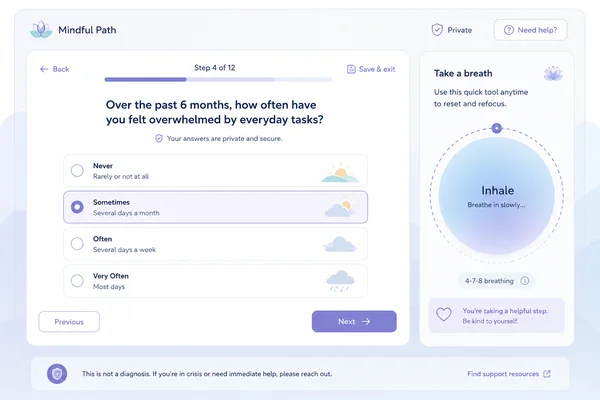
We recognize that evaluating your own behaviors can sometimes trigger subtle feelings of stress or anxiety. To protect your peace of mind, our platform includes built-in sensory features, such as soft breathing adjustment bubbles and minimalist focus timers. We highly encourage you to utilize these tools to quiet your physical surroundings before beginning your self-reflection. By managing environmental stressors and approaching the prompts in a grounded state, you ensure that your self-exploration remains an empowering, safe, and deeply informative experience.
The Science Behind the Framework: Evaluation of AQ-10 Reliability
Before dedicating your personal energy to a self-assessment tool, understanding its empirical foundation is deeply important. The scientific validation of the AQ-10 is rooted in extensive peer-reviewed data, demonstrating a high level of diagnostic sensitivity.
When researchers evaluate the aq 10 reliability index, they measure how effectively the brief tool captures individuals who genuinely require clinical support. Studies show that when the 6-point threshold is applied accurately, the questionnaire maintains a remarkably low rate of missing relevant traits. However, every short-form instrument has inherent operational boundaries. It cannot capture the entire nuance of an individual's lived experience, and factors like social masking can occasionally influence the accuracy of self-reported data. It stands as an excellent preparatory mechanism, but it must never be mistaken for a comprehensive clinical assessment.
Navigating Your Next Steps in Your Personal Self-Discovery Journey
Receiving your screening score should be viewed as an encouraging fresh start rather than a rigid label. Whether your total score lands below or well above the standard referral threshold, the primary objective of this exercise is to build a closer, more compassionate relationship with your own mind.
If your screening results reflect a strong alignment with neurodivergent patterns, consider compiling a personal self-observation checklist based on the five behavioral dimensions explored above. Documenting specific real-world examples of how you experience sensory sensory inputs, social batteries, and routine adjustments creates an incredibly valuable foundation. You can calmly bring these written insights to an educational self-assessment platform or a future discussion with a compassionate mental health professional. Embracing your unique cognitive profile is a gradual journey, and utilizing structured tools ensures that you navigate every step with profound confidence and self-validation.
Frequently Asked Questions
Is the AQ10 test free to access?
Yes, the AQ-10 framework is a public domain instrument that can be accessed completely free of charge on our home platform without any hidden fees or registration barriers.
What is the ideal age limit for the adult AQ-10 framework?
The adult version of the AQ-10 questionnaire is scientifically calibrated and validated for individuals who are 16 years of age or older.
Does an elevated AQ-10 score indicate a clinical diagnosis?
No, the AQ-10 is strictly an informational screening asset; a formal diagnosis requires a multi-layered evaluation conducted by a qualified healthcare specialist.